


When summer heat hits and the workday stretches past twelve hours, the last thing you need is a failing air conditioning system in your tractor cab. Whether you’re baling hay in July or running a combine through harvest in September, a properly functioning AC keeps you comfortable, alert, and productive. This guide covers everything you need to know about tractor air conditioning parts—from understanding how your system works to recognizing warning signs and choosing the right replacement components.
Key Takeaways
- Tractor air conditioning parts—including compressors, condensers, evaporators, expansion valves, blower motors, hoses, and receiver-driers—work together in a closed refrigerant loop to keep the cab cool and the operator focused during long field days.
- Modern tractor cabs from brands like John Deere and New Holland feature large glass areas (often 50-70% of the cab perimeter) that amplify solar heat gain, making a well-maintained AC system essential for 12-16 hour summer operations.
- Fab Heavy Parts (fabheavypart.com) supplies direct-fit replacement tractor air conditioning parts, including OEM-quality components designed for common agricultural models.
- Regular inspection and early replacement of worn AC parts prevent breakdowns during peak seasons like June through August, when downtime can cost $500-1,000 per day in lost productivity.
- Having an air conditioning system in a tractor significantly increases the comfort of the driver, which can lead to enhanced productivity during work—studies show properly cooled operators make fewer fatigue-related errors.
Tractor AC Basics
Tractor air conditioning matters more than you might think during long summer days in the field. Unlike a quick drive to town in your pickup, tractor work often means sitting in the cab for 10-16 hours at a stretch. A functioning tractor air conditioning system allows for year-round use of the tractor, regardless of weather conditions, making it a versatile tool for farmers.
Tractor cabs have lots of glass. That’s great for visibility, but it also traps heat and sunlight like a greenhouse. During harvest and hay season, cab interiors can easily reach 95-110°F when the ambient temperature sits around 90°F with high humidity. Without proper cooling, those temperatures become dangerous.
A tractor air-conditioning system operates through a process of compression, condensation, metering, and evaporation to cool and condition the air inside the cab. Beyond just cooling to a comfortable 68-72°F, these systems dehumidify the air (removing 20-40% of excess moisture) and filter out dust and pollen—critical protection when you’re spraying chemicals or working in dusty conditions. Tractors often have limited ventilation options, making an air conditioning system essential for maintaining a comfortable working environment, especially in hot and humid conditions.
Modern tractors from brands like John Deere 6R Series and New Holland T7 Series come from the factory with sealed, pressurized cabs that depend on a healthy AC system. These pressurized cabs maintain 0.5-1.0 inches water column pressure, blocking up to 95% of particulates from entering. Refrigerant is used in a tractor AC system to help move heat out of the cab and lower the temperature by recirculating air—most commonly R-134a, though newer models like the John Deere 8R series are transitioning to R-1234yf for regulatory compliance.

How Does a Tractor AC System Differ from a Regular Vehicle's AC System?
A pickup truck AC and a tractor AC use the same basic science—the vapor-compression refrigeration cycle. But that’s where the similarities end. Tractors face operating conditions that would destroy most automotive AC systems.
Tractor AC components are often mounted in tighter, hotter spaces near the engine and radiator, with far more exposure to dust, chaff, and vibration than road vehicles. Engine bay temperatures can hit 250°F, and condensers sit just inches from radiators where they accumulate debris that can reduce airflow by 50% if not cleaned regularly.
Many tractors run at steady RPM for hours during baling, planting, or combining. This keeps AC systems under heavy continuous load—tractors commonly log 500-1,000 hours annually at 1800-2200 RPM. Compare that to a car’s intermittent use, and you understand why agricultural AC components need to be built tougher.
Cab filters and outside air intake points on tractors are designed to block dust and crop debris, using cyclonic-style filtration that can trap 5 lbs of debris per season. These filters clog after just 100-200 hours in silage operations, demanding biweekly changes versus yearly swaps on cars. Some tractors route AC lines up the cab posts or through roof panels—sometimes 10-15 feet of hose—which makes hose condition and proper routing especially important since cab flex under shock loads can cause abrasion damage.
Core Tractor Air Conditioning Parts and What They Do
The “refrigerant loop” is the heart of your tractor’s cooling system. It’s a sealed circuit where refrigerant cycles continuously, absorbing heat from cab air and expelling it outside. The five primary components of a tractor AC system include the compressor, expansion valve, receiver drier, condenser, and evaporator. Here’s what each part does:
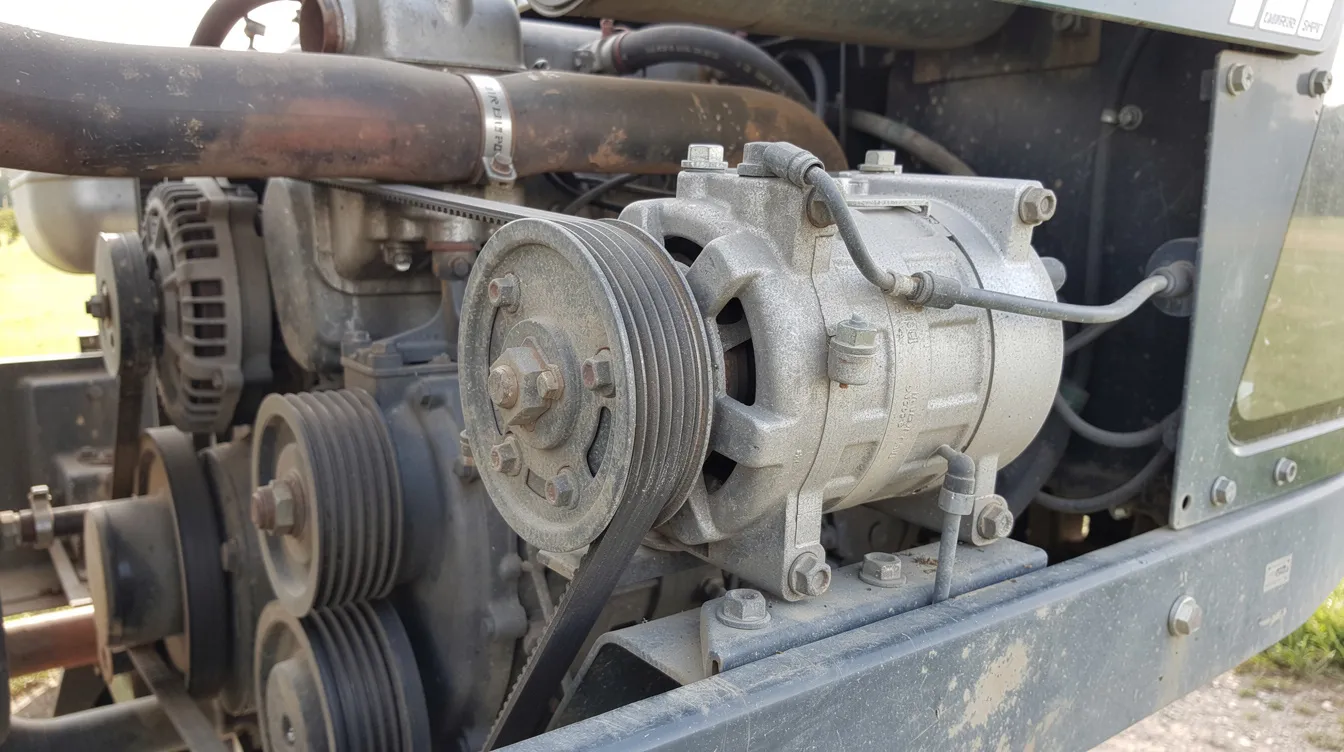
The compressor is belt-driven and mounted on the engine. It acts like a pump, compressing low-pressure refrigerant vapor into high-pressure gas (typically 200-300 psi). Common types include Sanden SD5H14 and York models. Typical failure signs include:
- Rattling or bearing whine noises
- Seized or slipping clutch (look for amp draw over 5A)
- No cold air under load
- Clutch short-cycling under 30 seconds
Condenser
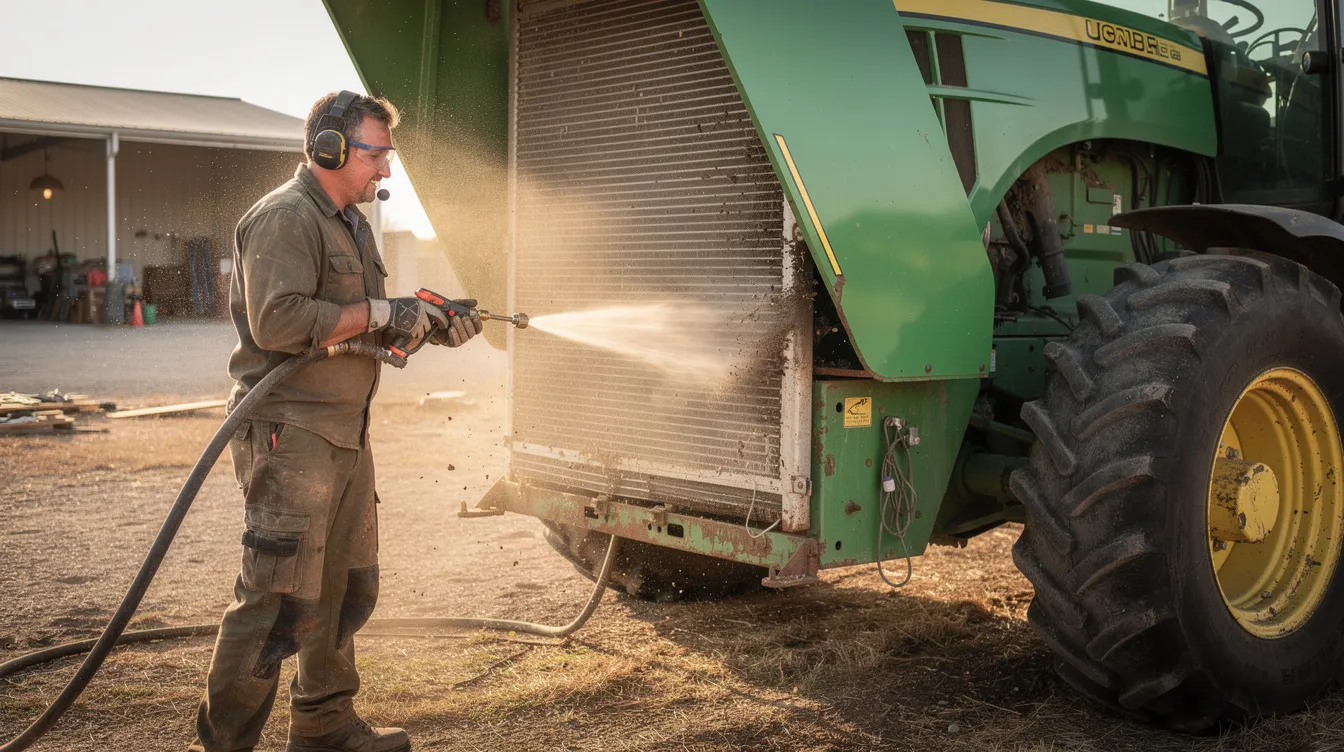
This is the radiator-looking unit mounted in front of the engine radiator. It releases 15,000-25,000 BTU/hr of heat, converting high-pressure refrigerant gas into liquid. On combines and tractors, condensers clog quickly with chaff—a 1/4” layer can spike head pressure to 400 psi and drop efficiency by 60%. Regular cleaning with compressed air at 30 psi clears 90% of debris.
Evaporator
The “cold coil” is located in or near the cab roof or dash. It absorbs 10,000 BTU/hr of heat as refrigerant evaporates inside. Symptoms of problems include weak cooling, icing up (if airflow drops below 300 CFM), or a musty smell from microbial growth—treat with coil foam cleaner.
Expansion Valve or Orific Tube
This component meters refrigerant into the evaporator, controlling flow rate (typically 0.5-1 lb/hr). Blockages or sticking from debris cause pressure issues and poor cooling. Orifice tubes have fixed openings (0.055-0.070” ID), while thermostatic expansion valves (TXVs) adjust based on conditions.
Receiver-Drier or Accumulator
This canister (8-12 oz capacity) removes moisture via desiccant beads and filters debris. It should be replaced any time the system is opened, a line is replaced, or a compressor is changed—desiccant saturates at about 4 oz of water.
Blower Motor and Fan
This part moves cool air through the cab vents at 300-500 CFM. Worn motors (especially after 5000+ hours) can squeal from dry bearings, run only on high speed due to failing resistors, or fail completely.
Hoses, Lines, Fittings, and O-rings
These carry refrigerant around the tractor. Over time, barrier-lined EPDM hoses (rated for 500 psi burst) can crack, rub through, or leak at joints—especially on older John Deere and New Holland models. Expect to see 0.5 oz/day leakage from worn seals, detectable with UV dye.
Signs Your Tractor AC Parts Need Attention
Catching AC problems early—before planting, haying, or harvest—prevents costly downtime when the weather is hottest. A pre-season check at $150 can save you from $3,000 repairs or worse.
Common symptoms to watch for:
|
Symptom |
Possible Cause |
|
Air not cold enough |
Low refrigerant, clogged condenser, failing compressor |
|
Air only cool when moving |
Condenser airflow issue, debris buildup |
|
Hot air at idle |
Compressor cycling off due to low charge |
|
Unusual compressor noises |
Bearing wear, clutch problems |
|
Short cycling (under 30 seconds) |
Low refrigerant, faulty pressure switch |
Tractor air-conditioning systems may experience wear and tear on their components, which can prevent the AC from operating properly. Visible signs of trouble include oily residue on hoses or fittings (indicating refrigerant leaks), excessive frost on suction lines (pointing to overfeed), and frequently tripping pressure switches.
Comfort-related signs shouldn’t be ignored either. Fogged or sweaty windows, strong musty odors from vents, or weak airflow in the cab can point to blower or evaporator issues. If gauges show low-side pressures below 25 psi or high-side above 300 psi, you’ve got a problem developing.
Quick visual inspection checklist before every season:
- Check belt tension on the compressor (1/2” deflection at 10 lbs force)
- Clean debris from condenser (80% open fin area is vital)
- Look for rubbed, kinked, or oil-stained AC hoses
- Inspect electrical connections at compressor clutch
Common Tractor AC Issues in Real-World Use
Tractors and combines often fail in mid-season heat because AC parts are working their hardest right when you need them most. Understanding common failure patterns helps you prepare.
Condenser clogging with chaff during hay and grain harvest ranks as the number one issue, especially on front-mounted condensers. Case IH Axial-Flow combines, for example, clog 70% faster in wheat chaff versus corn according to Abilene Machine case studies. This leads to high pressures, weak cooling, and forced shutdowns.
Older tractors from the early 2000s, including some John Deere 7000 series (like the 7710) and New Holland TS series (like the TS90), frequently develop leaks at hose crimps and O-rings. O-ring durometer drops about 20% after 10 years, causing 1 lb of refrigerant loss annually on many machines.
Common issues with tractor AC systems include problems with the compressor, expansion valve, and receiver drier, which may require timely repairs to avoid more serious damage. Running an AC system low on refrigerant overheats the compressor to 300°F, shedding aluminum debris that clogs TXVs and contaminates the entire system—necessitating $1,500+ flushes with RX-11 solvent and complete part replacement.
Blower motor wear on high-hour machines (5000+ hours) causes noisy operation, poor airflow, or only working on high fan speed due to failing resistors—airflow can drop by half on medium speeds.
Key Tractor AC Components to Replace (and When)
Some air conditioning parts are “wear items” and should be replaced proactively, not only after complete failure. Planning replacements during the off-season saves both money and frustration.
Receiver-drier or accumulator: Replace any time the system is opened, a line is replaced, or a compressor fails. The desiccant beads saturate after about 2 years, losing their ability to trap moisture. Protecting new parts from moisture and debris is essential.
Cab air filters: Change at least once per season, and more often in extreme dust conditions like silage chopping, fall tillage, or spraying. Heavy dust operations may require changes every 150 hours.
Rubber hoses and O-rings: These typically age out at 10-15 years, especially on tractors used for spraying or fertilizing where chemical exposure accelerates degradation. A full hose kit replacement ($400-800) may be worthwhile on older machines.
Compressor: A compressor with noisy bearings, 0.010” clutch gap wear, or amp draw over 5A may be cheaper to swap before it fails catastrophically and contaminates the whole system. Full-system overhauls after compressor grenades run $2,000-5,000.
Fab Heavy Parts can help customers identify correct part numbers using tractor model, year, and, when needed, OEM reference numbers from John Deere or New Holland catalogs.
Example: Replacing a John Deere Tractor AC Compressor
Consider a typical scenario: a 2015 John Deere 6150R row crop tractor needs a new AC compressor before summer. The Sanden compressor has logged 4500 hours and is showing signs of clutch slip and bearing noise.
Here are the steps at a high level:
- Confirm the correct compressor part number (e.g., AT123489 for this application)
- Safely recover refrigerant to 0 psi using proper recovery equipment
- Remove the drive belt
- Disconnect 6 AN fittings and refrigerant lines
- Swap compressor and replace all O-rings
- Install new receiver-drier (e.g., AL123280)
- Evacuate system to 500 microns
- Recharge with 2.2 lbs R-134a and 8 oz PAG 46 oil per spec
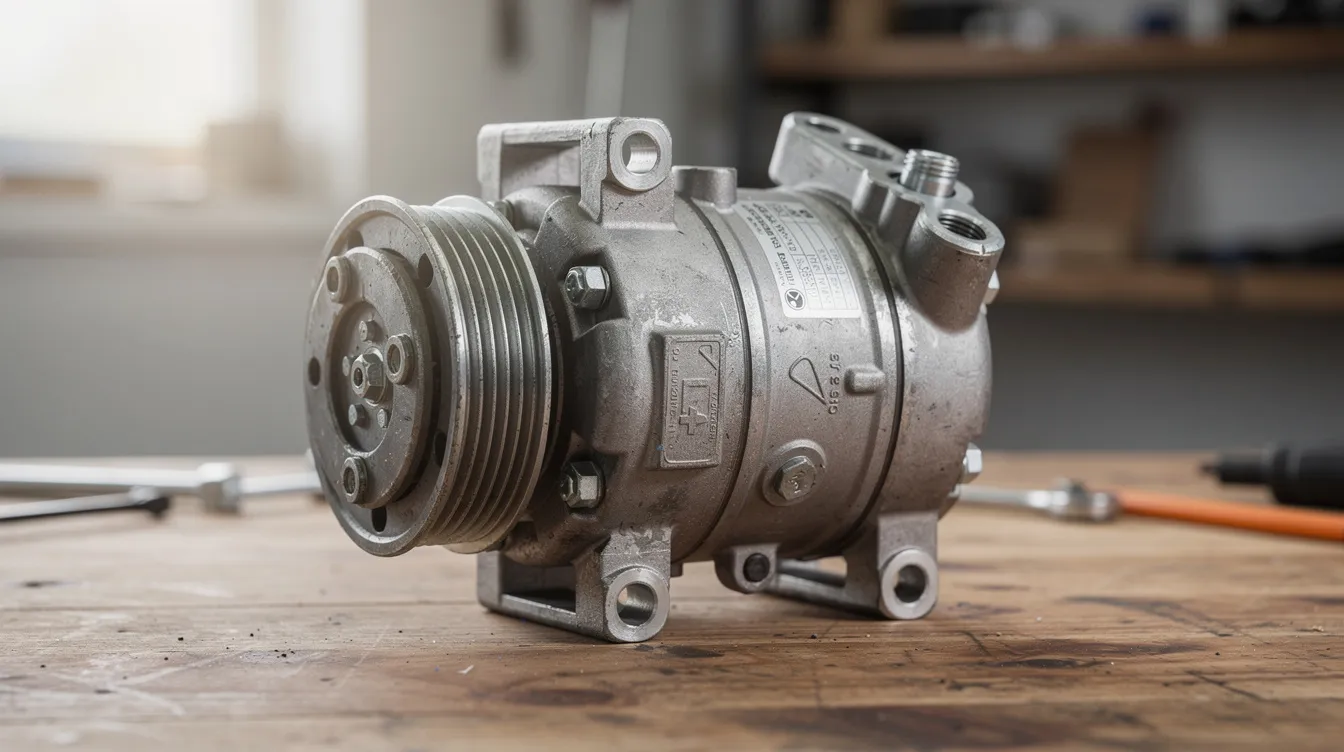
Fab Heavy Parts offers direct-fit replacement compressors for John Deere applications, designed to match OEM mounting points, pulley grooves, and electrical connectors. Using the right oil type and quantity in the new compressor is critical—always follow the service manual’s specifications.
If the old compressor failed catastrophically (metal shavings in the system), flush all lines and replace the orifice tube or expansion valve before reassembly.
Choosing the Right Tractor Air Conditioning Parts
Correct fit and quality matter more than ever in air conditioning components due to pressure, heat, and safety concerns. A mismatched pulley (6 vs 8 grooves, for example) can cause 20% efficiency loss. Incorrect evaporator mounts create installation headaches.
Match parts using:
- Exact tractor model and year
- Engine type
- Cab configuration (standard vs premium cab)
- Serial number range when applicable
Encourage yourself to cross-reference OEM numbers from John Deere or New Holland parts diagrams with compatible aftermarket options. Many OEM numbers have been superseded over the years—for instance, AR182436 hoses superseded by RE63627 on some John Deere models.
Select AC components rated for agricultural use, with vibration-resistant mounts and corrosion-resistant materials. Generic auto parts won’t survive 50G shock loads and constant dust exposure. According to AEM testing, quality aftermarket parts match OEM performance in 95% of applications.
Fab Heavy Parts focuses on heavy equipment and tractor components, allowing the company to stock parts that stand up to long days in the field. Planning purchases for key seasons (planting in April-May, haying in June-July, harvest in September-October) helps avoid rush delays and ensures parts arrive when you need them across the country.
Working with Fab Heavy Part for Your Tractor AC Needs
Fab Heavy Parts specializes in heavy-duty and agricultural equipment, with years of experience helping farmers and operators stay comfortable in the cab. Our focus on ag applications means we understand the demands your equipment faces.
Customers can use the fabheavyparts.com website to search by brand and model—John Deere, New Holland, Case IH, and more—to find matching air conditioning parts. Each page includes clear product descriptions listing dimensions, fittings, and refrigerant compatibility.
Our team can help track down hard-to-find components for older tractors, including discontinued or superseded compressor and hose part numbers. If you can’t find what you need, contact us with your tractor details and we’ll work to locate the right part. You can also request more information or assistance at any time to ensure you get the correct tractor air conditioning parts for your needs.
Maintenance Tips to Extend the Life of Tractor AC Parts
Basic preventive maintenance can easily add years to the life of a tractor’s air conditioning system. Regular servicing of a tractor’s AC system is crucial to ensure its proper function and longevity, as neglect can lead to costly repairs.
Maintenance requirements for a tractor AC system are the same as any other vehicle AC system—the difference is frequency and conditions. Here’s what to prioritize:
Weekly during heavy use:
- Blow out the condenser and radiator stack with low-pressure compressed air (90 psi max), especially during mowing, baling, and combining when debris builds quickly. Cleaning the condenser and keeping it free of debris is essential for the proper functioning of a tractor AC system.
Monthly during season:
- Inspect belt tension and condition, watching for glazing, cracking, or belt squeal on compressor start-up. Checking drive-belt tension is a critical maintenance requirement for ensuring the efficiency of a tractor’s air conditioning system.
- Run the AC system at least once a month even in cooler weather to keep seals lubricated and prevent refrigerant leaks.
Per operator's manual:
- Replace cab air filters according to guidelines. Regularly changing filters is an important maintenance task for a tractor’s air conditioning system. Clean fresh air intake areas around the cab roof or side panels.
Pre-season:
- Schedule an AC check with a qualified technician if the system is older, has borderline performance, or has shown early warning signs of failure. A $150 inspection catches 90% of issues before they become $3,000 repairs.
FAQ
Q1: How often should I service my tractor's air conditioning system?
A1: Most tractors benefit from a basic AC check once a year before hot weather, including cleaning the condenser, checking belt tension, and inspecting for leaks. Heavy-use machines running daily during summer may need filter changes and light cleaning multiple times per season. Follow your tractor’s operator manual for exact intervals, and schedule professional service if performance starts to drop.
Q2: Can I retrofit air conditioning on an older tractor that never had it?
A2: It is possible to retrofit an older tractor with an air-conditioning system. This can be done by learning to repair and diagnose AC systems or by hiring a professional diesel technician. Retrofitting involves understanding the tractor’s AC components and their functions. Costs typically include compressor brackets, hoses, condenser, evaporator, controls, and cab sealing—usually $3,000-6,000 for aftermarket kits like those from Vintage Roar. Contact Fab Heavy Parts with your tractor details to explore available components and pricing.
Q3: What refrigerant does my tractor use, and can I change it?
A3: Most tractors built in the last 20-25 years use R-134a refrigerant (global warming potential 1430), while some very new models are moving to R-1234yf (GWP 4) for EPA compliance. Converting from older refrigerants or switching types should only be done by qualified technicians using approved retrofit kits and following regulations. Check the label under the hood or in the cab for the factory refrigerant type and fill amount before adding or changing anything.
Q4: Are aftermarket tractor AC parts as reliable as OEM parts?
A4: High-quality aftermarket air conditioning parts designed specifically for agricultural use can perform just as well as OEM components when sourced from a trusted supplier. AEM testing shows 95% equivalence in properly spec’d aftermarket parts. Fab Heavy Parts focuses on heavy equipment and selects components built to handle vibration, dust, and long working hours in the field. Avoid generic, no-spec parts and instead choose components with clear compatibility listings and warranty support.
Q5: What information do I need before ordering tractor AC parts online?
A5: Have the exact tractor brand, model, and year ready, and when possible, the OEM part number from your parts book or dealer invoice. Photos of existing components and information about cab type or optional packages can also help ensure a correct match. Reach out to Fab Heavy Parts with this information so the team can quickly confirm the right replacement parts for your machine.
Popular Air Conditioning Compressors at Fab Heavy Parts
1.

Part Number: 345-4547, CA345-4547, 3454547, 5093951, 50939513, 32800G, C05104C
Specification: Model: SD5H09; Volts: 12V; Clutch Diameter: 125mm; No. of Grooves: 2 groove
Applications: The A/C Compressor fits for Caterpillar Compact Track Loader: 259D, 279D, 289D, 299D, 299D XHP; Caterpillar Multi Terrain Loader: 257D, 277D, 287D; Caterpillar Skid Steer Loader: 236D, 242D, 246D, 262D, 272D, 272D XHP
Condition: new, aftermarket
2.

Part number: RD451-93900, RD45193900
Condition: new, aftermarket
Voltage: 12V
Application: The Air Conditioning Compressor fits for B, BX Series B3150HDCC; Compact Track Loader SVL75 SVL75C SVL90 SVL95; Excavator(K / KH / KX / U SERIES) KX033 KX040 KX080 U48 U55; EXCAVATOR(KH / KX / K / U SERIES) KX057 U35; L Series L4240HSTC L5240HSTC L5740HSTC; M Series M110GXDTC M8540DCN M8540DHC M9540DHC; Skid Steer Loader SSV65 SSV65PC(S SSV75 SSV75PC(S; TRACTOR L SERIES L4240HSTC L5240HSTC; TRACTOR M SERIES M100GXDTC M100XDC M108SDC M110XDC M6040DHC M7040DHC M7040FC M8540DTNQPC M9540DHC; Wheel Loader(R SERIES) R065 Kubota
3.

Condition: new, aftermarket
Part number: 7023583
This AC compressor w/ clutch Aftermarket Replacement For Bobcat Skid Steer Loader S550 S570 S590 T550 T590
**Fab Heavy Parts is an independent reseller and it is not affiliated with any compact equipment manufacturer.
4.
 A/C Compressor RE284680 Fits for John Deere Tractor Serie 5000/6000 5065M 5085M 6105M
Condition: new, aftermarket
Part Number: RE284680, 51428, RE502697, 447280-1650, 4472801650, 447280-2000, 4472802000, 503-166, 503166, 503-1663, 5031663
Specification: Volts: 12V; Clutch Diameter: 125mm; No. of Grooves: 8 groove; Belt Type: Serpentine
Compressor Mount: Direct; Fitting Style: Pad; Model: 10SRE18C
Application: The A/C Compressor fits for John Deere Tractor 5065M, 5075M, 5083EN, 5085E, 5085M, 5093EN, 5095M, 5095MH, 5100E, 5100M, 5100MH, 5101E, 5101EN, 5105M, 5115M, 6090RC, 6100MC, 6100RC, 6105D, 6105M, 6105R, 6110RC, 6115D, 6115M, 6115R, 6125M; John Deere Loader 310K, 310SK, 315SK, 325K, 325SK, 410K, 710K, 210K, 344K, 310K, 410KTC
5.
 24V 10PA15C A/C Compressor 5031228 Fits for Doosan Daewoo Excavator DX225
Part number: 503-1228, 5031228
Specification: Model: 10PA15C; Volts: 24V; Clutch Diameter: 145 mm; No. of Grooves: 8 groove
Applications: The A/C Compressor fits for Doosan Daewoo Excavator: DX225
Condition: new, aftermarket
6.
 Air Conditioning Compressor 84159489 Fit Case Backhoe Loader 580N 580SN 590SN 580SN
Part number: 84159489
Application: The Air Condtioning Compressor fits for CROP PRODUCTION EQUIPMENT PATRIOT 3240 PATRIOT 3340; ENGINES F4HFE613F B004; LIGHT EQUIPMENT 580N 580SN 580SN WT 590SN Fits Case
Condition: new, aftermarket
FAB Heavy Parts: Your Trusted Engine Parts Supplier
Welcome to Fab Heavy Parts' online catalog, your trusted source for quality auto parts and tools. Explore our extensive selection of Air Conditioning Compressor and more. Avoid delays by securing the parts you need from a reliable supplier who keeps inventory moving. Our expert team is here to provide personalized support, ensuring you get the right parts. Reach out today to stay ahead and keep your operations seamless!