


Your engine depends on clean fuel to run right. A fuel filter is the unsung hero that makes that happen, catching contaminants before they reach sensitive components. Understanding how this small part works—and when to replace it—can save you from expensive repairs and unexpected breakdowns.
Key Takeaways
- A fuel filter removes dirt, rust, and harmful debris from diesel or gasoline before it reaches the engine, protecting injectors, pumps, and overall performance.
- Most vehicles need a fuel filter replacement between 20,000 and 40,000 miles, though some newer platforms have "lifetime" intervals--always check your owner's manual.
- Watch for hard starting, loss of power under load, stalling, rough idling, poor fuel economy, and a check engine light as warning signs.
- Ignoring a clogged filter can damage high-pressure fuel pumps and fuel injectors, which cost far more to replace than the filter itself.
- Fab Heavy Parts specializes in high quality fuel filters and related components for trucks and equipment, helping match the right filter to your specific make and model.
What Is a Fuel Filter?
A fuel filter is a small but essential component in your vehicle’s fuel system that screens contaminants before fuel reaches the engine. Think of it as a barrier that keeps your precision components safe.
The filter media—made from paper, synthetic fibers, or multi-layer materials—traps particles like dirt, rust flakes from the tank, and metal shavings. Quality parts can block contaminants as small as 10 microns, roughly one-fifth the diameter of a human hair.
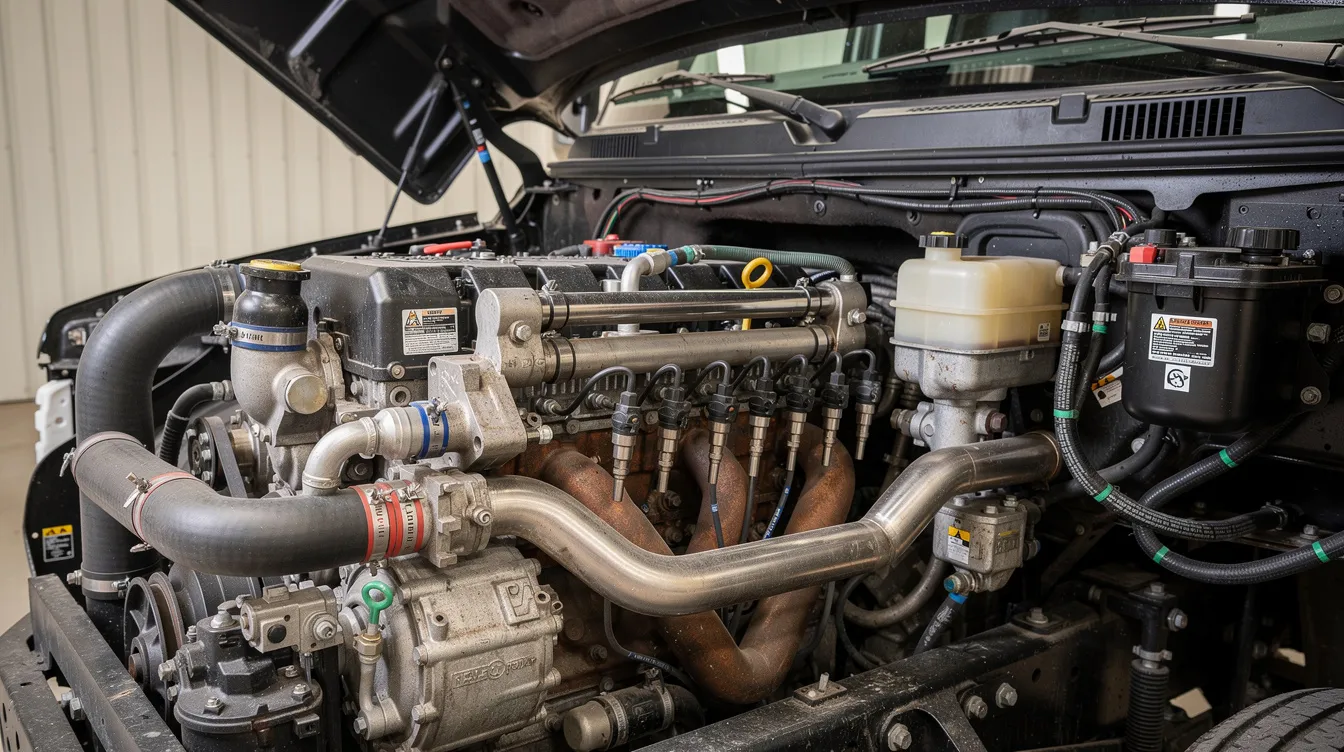
Here’s the typical fuel path: gas tank → pickup → fuel pump → fuel filter → fuel rail → injectors. The filter sits between the tank and the fuel injection system. Diesel systems operate at higher pressures than gasoline engines and often require water separation alongside particle filtration. In modern engines with tight clearances--direct injection gasoline since the early 2010s and high-pressure common-rail diesels since the mid-2000s--even tiny particles can cause costly damage to the fuel delivery system.
Types of Fuel Filters and Where They're Located
Filter type and location depend heavily on whether you’re working with a light-duty car, SUV, or heavy-duty truck and off-highway equipment.
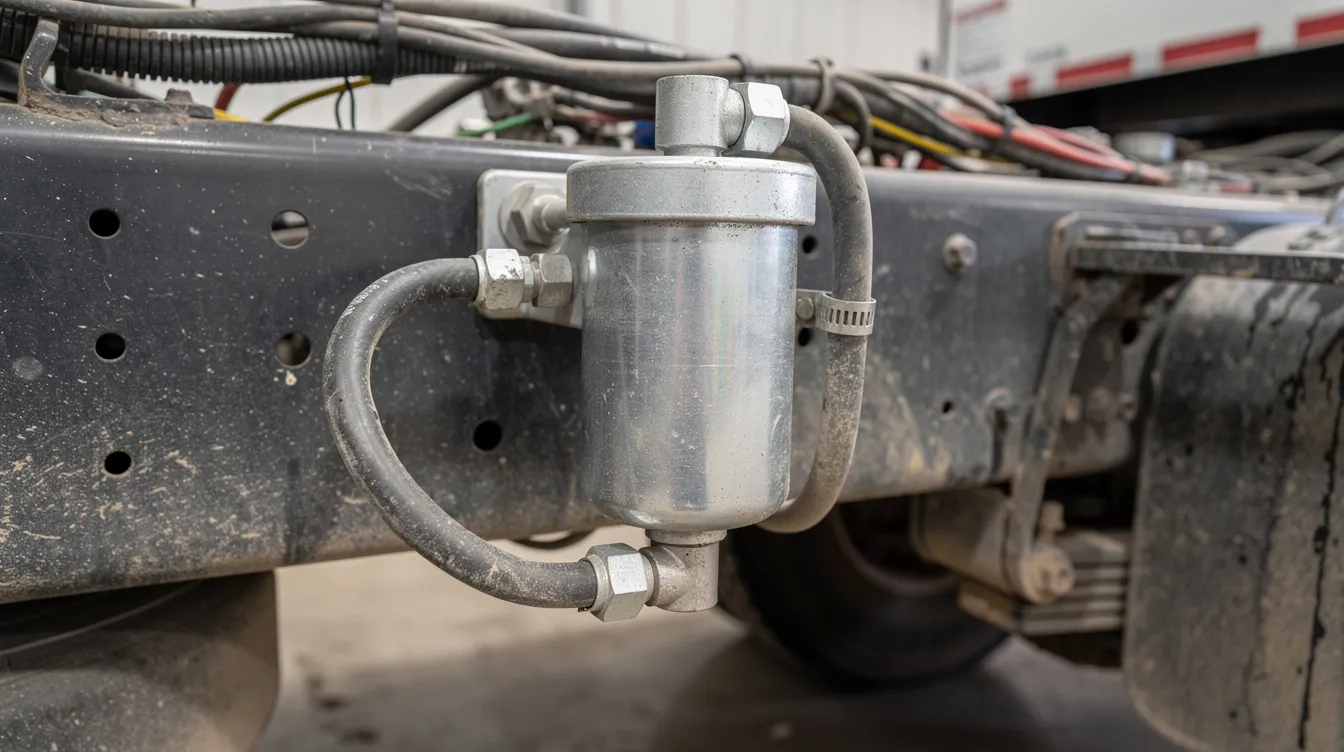
Inline filters mount along the fuel line under the vehicle or in the engine bay. They’re common on older vehicles and many heavy-duty trucks—often the most DIY-friendly option.
Tank-mounted filters are integrated with the fuel pump module, especially on passenger vehicles from the late 2000s onward. These are harder to service since accessing them may require dropping the fuel tank.
Cartridge-style filters sit in canisters, common on modern diesel pickups. You replace the inner cartridge element but reuse the housing.
Spin-on diesel filters and fuel/water separators look like oil filters. They’re often mounted on the frame rail of medium- and heavy-duty trucks and perform dual functions: particle filtration and water separation.
Check under-hood labels, your owner’s manual, or service information to find the exact filter style and location for your specific year, make, and model.
Why a Fuel Filter Matters for Performance and Longevity
Clean fuel is as crucial as clean oil. The fuel filter is your primary defense between contaminated fuel and precision components that cost serious money to replace.
A clean filter maintains proper fuel pressure and spray pattern at the injectors. This supports smooth acceleration, consistent power, and optimal performance under load. It also protects the fuel pump from debris-induced wear and heat stress, extending pump life and reducing sudden breakdowns.
Filtration directly impacts fuel economy. An engine struggling for fuel runs inefficiently, leading to increased power demands and higher consumption over thousands of miles. Poor atomization from restricted flow can also increase soot and hydrocarbon emissions, especially in diesel engines.
Consider the cost comparison: a typical fuel filter might run under $100 installed. A modern high-pressure fuel pump and injector set on a diesel truck? That can climb into thousands of dollars. Routine maintenance wins every time.
Common Signs Your Fuel Filter Needs to Be Replaced
Filters clog slowly, so symptoms often appear under load, on hills, or during hot starts before showing up at idle.
Watch for these warning signs:
- Difficulty starting or extended cranking, especially after the vehicle sits overnight—restricted flow delays proper pressure build-up
- Sluggish acceleration, hesitation, or flat spots when merging or passing
- Rough idle, shaking, or occasional engine misfires at stoplights
- Random stalling while driving or at idle, particularly if the engine restarts after a few minutes
- Reduced fuel economy and a general “tired” feeling from the engine running below par
- Check engine light with codes related to fuel trim or fuel pressure
Don’t ignore new fuel pump noises like whining or buzzing from the tank area. A struggling pump often points to a plugged filter or pickup screen causing flow restriction.
What Causes a Fuel Filter to Clog?
Filters are designed to clog slowly as they perform their function. The key is replacing them before restriction causes problems.
Normal buildup includes microscopic dirt and rust from underground storage tanks and your vehicle’s own fuel tank. Age-related tank corrosion, especially on older steel tanks and equipment stored outside, sheds rust and scale into the fuel system.
Water contamination is a major concern for diesel fuel, particularly in humid climates and on equipment that sits unused. Water encourages microbial growth—the “diesel bug”—that plugs filters and creates impurities throughout the system.
Poor-quality fuel, fuel stored in dirty containers on farms and construction sites, extended service intervals, and running the tank near empty can all accelerate filter clogging and contamination.
When Should You Replace Your Fuel Filter?
There’s no single mileage that fits every vehicle. Intervals depend on design, fuel type, and driving conditions.
General guidelines:
|
Vehicle Type |
Typical Interval |
|
Light-duty vehicles |
20,000–40,000 miles |
|
Heavy-duty trucks |
500 hours or annually |
|
Farm/construction equipment |
Follow OEM schedule |
Some platforms from the 2010s onward have filters integrated with the pump listed as “lifetime”—but this means under normal conditions, not indefinitely. If symptoms appear, replace it.
Consider replacing sooner if your vehicle regularly tows heavy loads, idles for long periods, runs on off-road diesel, or operates in dusty environments. Pair fuel filter replacement with other routine maintenance like oil changes to make it easier to remember.
DIY Fuel Filter Replacement vs. Professional Service
Some fuel filters are simple to replace in a driveway. Others—especially in-tank assemblies—are better left to trained technicians.
Any fuel system work should start by relieving fuel pressure and disconnecting the battery. This reduces the risk of fuel leaks, injury, or fire.
DIY-friendly setups include accessible inline filters or spin-on filters on the frame rail that use quick-connect fittings or simple clamps. In-tank filters and integrated pump modules usually require lowering the fuel tank, which adds complexity and safety concerns.
Always work in a well-ventilated area away from open flames. Wear safety glasses and gloves. Collect spilled fluids in an approved canister for proper disposal.
If you’re unsure about your skill level, choose professional installation. Incorrect installation—backwards flow, loose fittings, wrong part number—can create leaks or leave your vehicle unable to start.
Choosing the Right Fuel Filter for Your Vehicle or Equipment
Not all fuel filters are interchangeable. Using the wrong filter can cause restriction, leaks, or sacrificing filtration quality.
Key details for correct matching:
- Year, make, model
- Engine code or displacement
- VIN (sometimes required)
- Gasoline or diesel
Micron rating matters. Smaller ratings mean finer filtration—critical for high-pressure diesel systems—but the filter must still allow adequate flow.
Understand the difference between OEM-equivalent replacement filters and heavy-duty filters designed for severe service or extended intervals. For heavy-duty and industrial applications, cross-referencing OEM part numbers to quality aftermarket fuel filters is valuable.
Keep spare filter kits on hand for work trucks, farm tractors, and off-road equipment. When you’re in the field and notice symptoms, having the right parts ready minimizes expensive downtime.
How Fab Heavy Parts Helps Keep Your Fuel System Protected
Fab Heavy Parts specializes in components for heavy-duty trucks, industrial equipment, and off-highway machines—including fuel filters and related parts.
The focus is practical, reliability-centered: durable components that stand up to real-world use, not just spec-sheet promises. The website lets you search by equipment type, brand, model, or OEM part number to quickly find compatible filters and kits.
Fab Heavy Parts supports technicians, fleet managers, and owner-operators with knowledgeable customer service that helps confirm cross-references and answer fitment questions. They also store complementary fuel system parts—water separators, filter heads, seals, and brackets—so you can complete jobs with everything needed in one order.
Visit the site before your next service interval to plan downtime, order the right filters ahead, and fix potential problems before they become emergency repairs.
FAQ
Q1: Can a clogged fuel filter damage my engine permanently?
A1: A clogged fuel filter mainly stresses the fuel pump and injectors by starving them of fuel and causing them to overwork, which leads to premature failure. If the engine runs lean for extended periods, higher combustion temperatures may cause internal damage, especially on turbocharged engines. Replacing the filter at the first sign of trouble usually prevents permanent damage—but ignoring symptoms can turn a minor maintenance item into a major repair.
Q2: Is it safe to drive with a bad fuel filter for a while?
A2: While the vehicle may still run with a partially clogged filter, doing so increases the risk of sudden stalling and strains the fuel pump. Loss of power when merging, passing, or pulling a trailer creates safety concerns in traffic or on steep grades. Schedule a filter replacement as soon as symptoms appear rather than waiting until the vehicle won’t start.
Q3: Does fuel type affect filter life?
A3: Using high-quality fuel from reputable stations helps the filter last closer to its intended interval. Poor-quality or contaminated fuel, off-road diesel stored in bulk tanks, and bio-blends that attract moisture can shorten filter life significantly. Equipment running on farm or jobsite fuel should have filters checked more often, and water separators should be drained regularly.
Q4: Do I really need to change the fuel filter if my vehicle has a "lifetime" filter?
A4: “Lifetime” typically means expected service life under normal conditions—not that the filter will never clog. If symptoms of fuel starvation appear, or there’s evidence of contaminated fuel, replacing even a so-called lifetime filter may be necessary. Consult factory service information to see what’s involved for your specific vehicle.
Q5: Should I replace my fuel filter at the same time as my fuel pump?
A5: It’s smart practice to replace the fuel filter whenever replacing a fuel pump, especially if the old pump failed from wear or overheating. Installing a new pump with a partially clogged filter can shorten pump life and may not resolve low-pressure complaints. Many OEM and aftermarket pump kits now include or recommend a new filter as part of the repair.
Popular Fuel Filters at Fab Heavy Parts
1.
 Fuel Filter RE569926 RE530385 Fits for John Deere 540H 548H 640H 640G 648H 648HTJ
Condition: new, aftermarket
Part Number: RE559944, RE530385, RE569926
Application: The Fuel Filter fits for John Deere 540H, 548H, 640H, 640G, 648H, 648HTJ
2.

Condition: new, aftermarket
Part Number: 2325877, 228-9129, 32A62-02010
Cross Reference: BALDWIN BF7746-D, Fits for CATERPILLAR 228-9130, DONALDSON P551433, MAHLE FILTER KC 116
Compatible Equipment Models: The Fuel Filter fits for BACKHOE LOADER 414E, 416D, 416E, 420D, 420E, 422E, 424D, 428D, 428E, 430D, 430E, 432D, 432E, 434E, 442D, 442E, 444E; COMPACT WHEEL LOADER 914G; INTEGRATED TOOLCARRIER IT14G; TRACK-TYPE TRACTOR D3G, D4G, D5G Fits for Caterpillar
3.
 Fuel Filter Assembly 8980139861 8981438260 Fits for Isuzu 6HK1 4HK1 Hitachi ZX140 ZX160
Manufacturing Part Number: 8980139861, 8981438260
Condition: new, aftermarket
Applications: The Fuel Filter is compatible with Isuzu 6HK1, 6WG1, 4JJ1, 4HK1 Engine; John Deere Excavator: 220DW, 225DLC, 450DLC, 650DLC, 850DLC; Hitachi Excavator: PZX450-HCME, TL1100-3, ZX140W-3, ZX140W-3-AMS; Hitachi Crane: SCX400-C3, SCX400T-C3, SCX500, SCX550, SCX700-2, SCX700-C3, SCX800-2, SCX800HD-2, SCX900-2C3; Hitachi Mobile Crusher: ZR260HC, ZR950JC...
4.
 Fuel Filter Assembly 84392298 Fits for Case 121F 21F 221F 321F 570NXT 580N 580SN 590SN
Replace Part Number: 84392298, 84528620
Application: The Fuel Filter fits for CASE Compact Wheel Loader: 121F, 21F, 221F, 321F; CASE Backhow Loader: 570NXT, 580N, 580SN, 580SN WT, 590SN; CASE Forklife: 586H, 588H
Condition: new, aftermarket
5.
 Fuel Filter with Pump 32A62-02020 for Mitsubishi New Holland Perkins
Replace Part Number: 32A62-02020, 32A6202020
Applications: The Fuel Filter fits for Mitsubishi, New Holland, Perkins
Condition: new, replacement
6.
 Fuel Filter 6668639 6670995 Aftermarket Replacement For Bobcat Skid Steer Loader 963
Replace Part Number: 6668639, 6670995
Applications: The Fuel Filter is Aftermarket Replacement For Bobcat Skid Steer Loader: 963
Condition: new, aftermarket
** Fab Heavy Parts is an independent reseller and it is not affiliated with any compact equipment manufacturer.
FAB Heavy Parts: Your Trusted Engine Parts Supplier
Welcome to Fab Heavy Parts' online catalog, your trusted source for quality auto parts and tools. Explore our extensive selection of Fuel Filters and more. Avoid delays by securing the parts you need from a reliable supplier who keeps inventory moving. Our expert team is here to provide personalized support, ensuring you get the right parts. Reach out today to stay ahead and keep your operations seamless!